Experiential marketing focuses on providing the consumer with an experience and inviting them into a certain lifestyle. The experience is tailored to be sensory, emotional, and representative of the brand while promoting meaning and trying to configure brand loyalty
(Soloaga & Guerero, 2016). When discussing the framework of experiential marketing, the “experience providers” list includes electronic media, communications, visual/verbal identity, and signage (Schmitt, 2000) all of which are found in fashion film as a communication tool itself.
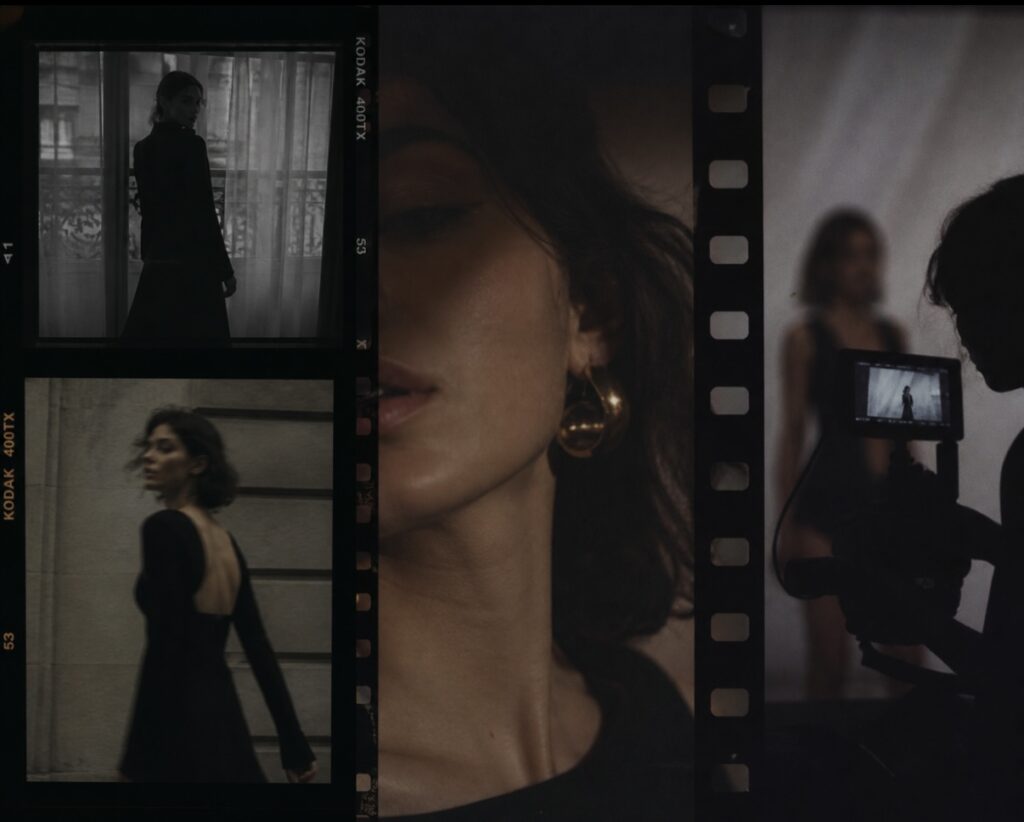
Furthermore, experiential marketing has a major showcasing feature to it, whereby the experience is of a certain spectacle and entertainment genre (Roberts,2018). In fact, there is a link pertaining to the entertainment constituent in it which was pointed out by Hackley and Tiwaskul (2006) who talked about : “ The role that entertainment marketing techniques may play in facilitating consumer self-concepts and identity formation through brand exposure within dramatic portrayals of characters and lifestyle” (Hackely & Tiwaskul 2006, p.63) .Throughout the years, different published analyses on the notion of consumers experiencing a brand have been brought up (Brakus et al., 2009; Atwal and Williams, 2008; Schmitt, 1999b; Chang and Chieng, 2006; Ha and Perks, 2005; Kent, 2011, as cited in Ueacharoenkit & Cohen, 2011). As well, a study that was done in 2009 tried to quantify the measure of a brand experience (Brakus et al., 2009), and they all poured into the acknowledgment of brands of how this entertaining experience adds a lot of value for companies (Brakus et al., 2009). Customers are intrinsically looking for more than tangible goods from a brand in order to fulfil their needs (Vandenbosh & Dawar, 2002, as cited in Ueacharoenkit, 2011). Research has proven that through an experience provided by the brand, these consumers could indeed get to have a fulfilling encounter that, if captivating enough, could trigger in them a certain attainment and a sense of belonging to a brand (Ueacharoenkit & Cohen, 2011). Moreover, fashion brands, especially luxury fashion, are nowadays oriented towards the portrayal of a hyper-reality and an orientation towards creating experiences. Through these exploitations, their aim is to seduce consumers by using interactivity, connectedness, and outstanding creativity in terms of the moving image. Moving forward with this realization, high-end brands such as Chanel, Dior, and Louis Vuitton, and later on other fashion brands with a more mass- market audience such as H&M, resorted to collaborating with known film directors to produce fashion films that deliver a rich multisensory experience for the consumer at reach.
Thus, they became reliant on the use of fashion film as tool for providing an ultimate experience. On top of that, the reasons for why fashion films were found to be the best go to tools when emulating a powerful sensory experience is due to the fact that in the process of doing so in the digital world, experiential marketing battles with the obstacle that is the ability to provide the audience with a kinesthetic experience, and fashion films have the ability to transmit this adventure (Soloaga & Guerero, 2016). What is meant by kinesthetic experience is the undergoing of a phenomenon that gives consumers the opportunity to test senses in an unusual manner, such
as the feeling of “touching” the fabric’s quality, and when it comes to sight and smell the involvement allows the consumer to visually catch a scent Schmit, 2006). With the digital revolution and the changing dynamic of the modern era, luxury brands could not get the job done with only building up an aura of exclusivity that they communicate with their clients. To maintain their desirability, luxury brands had to understand that the 21st century customer
wanted to feel a certain belonging and become part of a luxury brand’s affiliated universe andfeel allowed and invited to do so (Soloaga & Guerero, 2016, p. 50).
Accordingly, they worked on curating that experience through fashion film and made sure to incorporate an aesthetic reminiscent of their aristocratic values among other values pertaining to the brand in question (Soloaga & Guerero, 2016). Along with the translation of a multisensory “felt” experience digitally, fashion films have a huge power when it comes to generating significance which is also an important part of the brand’s world. It is what distinguishes a specific brand and its world from another (Roberts, 2018). When it comes to positioning fashion in a fictional world of the brand’s creation, it is not so much about explaining the function of clothes per say, but it is about making sure that the products of a certain brand or the idea of what these products stand for are placed in a context that the consumer would want to be part of (Wang & Juhlin, 2020). The entire concept of emphasizing the elements and the details from within the fashion film presented reinforces the concept of brand=experience which is a perspective that established its first notions along with the start of the revolution of experiential marketing. Experiential marketing came out of a need to adapt to an era that values the experience of the customer, and fashion film emerged as one popular tool for translating brand narratives into virtual experiences.

Leave a Reply